Mom Guilt, Overwhelm & the Pressure to Get Motherhood Right

You love your kids.
You think about them constantly. You make sure they have what they need. You remember the school forms, appointments, favorite snacks, spirit days, birthday parties, medicine doses, missing water bottles, and the hundred other things that somehow live in your head.
You worry about whether they’re happy.
Whether you’re patient enough.
Whether you’re spending enough time with them.
Whether you’re working too much.
Whether you’re doing too much for them…or somehow not enough.
You might lie in bed at night replaying the moment you lost your patience earlier that day. You remember the look on your child’s face when you raised your voice, while conveniently forgetting the twenty-seven other moments when you hugged them, helped them, listened to them, fed them, encouraged them, drove them somewhere, answered another question, or simply showed up.
And underneath all of that may be a question you don’t say out loud very often:
Why don’t I feel like a good mom?
Maybe everyone else seems to think you’re doing fine.
Your kids are cared for. You get things done. From the outside, your family may even look happy and put together.
But inside?
You’re not so sure.
Maybe motherhood feels harder than you expected.
Maybe you thought you would be more patient.
More present.
More organized.
More grateful.
Maybe you imagined you would somehow feel like a mom who knows what she’s doing.
Instead, you’re tired. You second-guess yourself. You lose your patience sometimes. You want a break and then feel guilty for wanting one.
And no matter how much you do, part of you still wonders whether a better mom would be doing more.
If that sounds familiar, there may be something important to understand:
Feeling like you’re failing at motherhood does not mean you are failing.
Sometimes it means the standard you’re using to judge yourself has become impossible to meet.
And sometimes anxiety, perfectionism, mom guilt, burnout, old family patterns, and the enormous mental load of motherhood have become so intertwined that it’s difficult to see yourself clearly anymore.
“I Love My Kids. So Why Do I Feel Like I’m Failing as a Mom?”
This is one of the most painful contradictions of motherhood.
You can love your children deeply and still feel overwhelmed by caring for them.
You can be grateful to be a mother and still miss parts of your life before motherhood.
You can enjoy your children and still desperately need time away from them.
You can have a wonderful day together and still count the minutes until bedtime.
You can be patient most of the day and still lose your temper at 7:43 p.m. when someone asks for one more snack after you’ve already cleaned the kitchen.
None of these experiences cancel out your love for your children.
But when you have an image in your mind of what a “good mom” is supposed to look like, normal human moments can start feeling like evidence against you.
Maybe a good mom is always patient.
A good mom loves playing.
A good mom makes healthy meals.
A good mom doesn’t yell.
A good mom keeps the house organized.
A good mom enjoys every stage because “it goes so fast.”
A good mom is emotionally available but also teaches independence.
She works, but not too much.
She takes care of herself, but never in a way that inconveniences anyone else.
She creates traditions, remembers picture day, volunteers at school, plans birthdays, keeps track of appointments, maintains friendships, nurtures her relationship, stays on top of laundry, limits screen time, makes magical childhood memories, and somehow remains calm while doing all of it.
When you put it that way, it sounds impossible.
Because it is.
Yet many mothers quietly use some version of this standard to evaluate themselves every day.
And when the standard is perfection, even a loving, involved, thoughtful mother can walk away feeling like she failed.
Why Do I Constantly Feel Like a Bad Mom?
If you constantly feel like a bad mom, it may have less to do with how much you love or care for your children and more to do with how you evaluate yourself as a mother.
Mom guilt often grows when your expectations for yourself are much harsher than the expectations you would ever place on someone you love.
Think about another mother you care about.
If she told you:
“I snapped at my kids this morning because we were late.”
Would you immediately decide she was a bad mother?
Probably not.
You might think she was stressed.
Human.
Overstimulated.
Running late with children, which may deserve its own category of stress.
But when you lose your patience?
Your mind may tell a very different story.
I should have handled that better.
Why can't I just stay calm?
I'm messing them up.
Other moms don't struggle with this as much as I do.
I need to do better tomorrow.
That last one can be particularly powerful.
Because tomorrow arrives, and you try harder.
You promise yourself you'll be more patient.
You'll put your phone down.
You'll stop worrying about the house.
You'll make dinner earlier.
You'll play more.
You'll yell less.
You'll enjoy them more.
And maybe you do some of those things.
But eventually you're tired again. Someone melts down. The morning goes sideways. Work runs late. Siblings start arguing. You become overstimulated.
And suddenly the promise you made yourself feels broken.
So you decide you need to try even harder.
This is how mom guilt can turn into a cycle of perfectionism.
You don't feel good enough, so you demand more of yourself.
Demanding more leaves you depleted.
Being depleted makes patience and emotional regulation harder.
Then the moments when you struggle become “proof” that you weren't good enough in the first place.
And the cycle begins again.
You May Be Measuring Motherhood by Your Hardest Moments
There’s something anxiety is very good at doing: zooming in.
It can take one difficult moment and make it feel like the whole story.
Maybe you raised your voice this morning.
Your brain remembers that.
But it doesn't give equal attention to the fact that you also made breakfast, helped find the missing shoe, kissed a scraped knee, listened to a story that took twelve minutes to explain, answered seventeen questions, checked homework, gave a hug, and made your child laugh.
You remember the five minutes when you weren't the mother you wanted to be.
You forget the other hours when you were simply being their mom.
This can become even stronger if you're someone who has always been hard on yourself.
Maybe long before motherhood, you were the person who tried to get things right.
You were responsible.
Dependable.
The one who remembered.
The one people could count on.
Maybe doing well became part of how you understood yourself.
And then you became a mother.
Suddenly you entered a role where there is no perfect performance.
There is no finished checklist.
No final grade.
No point at which someone hands you a report card and says:
Congratulations. You're officially doing motherhood correctly.
There will always be another decision.
Another stage.
Another worry.
Another parenting article telling you something you should—or absolutely should not—be doing.
For someone accustomed to measuring herself by how well she performs, motherhood can feel especially unsettling.
Because how do you know when you're doing enough?
The Invisible Mental Load Can Make You Feel Like You’re Never Doing Enough
Sometimes what sounds like:
“I’m not a good mom.”
is actually:
“I’m carrying too much.”
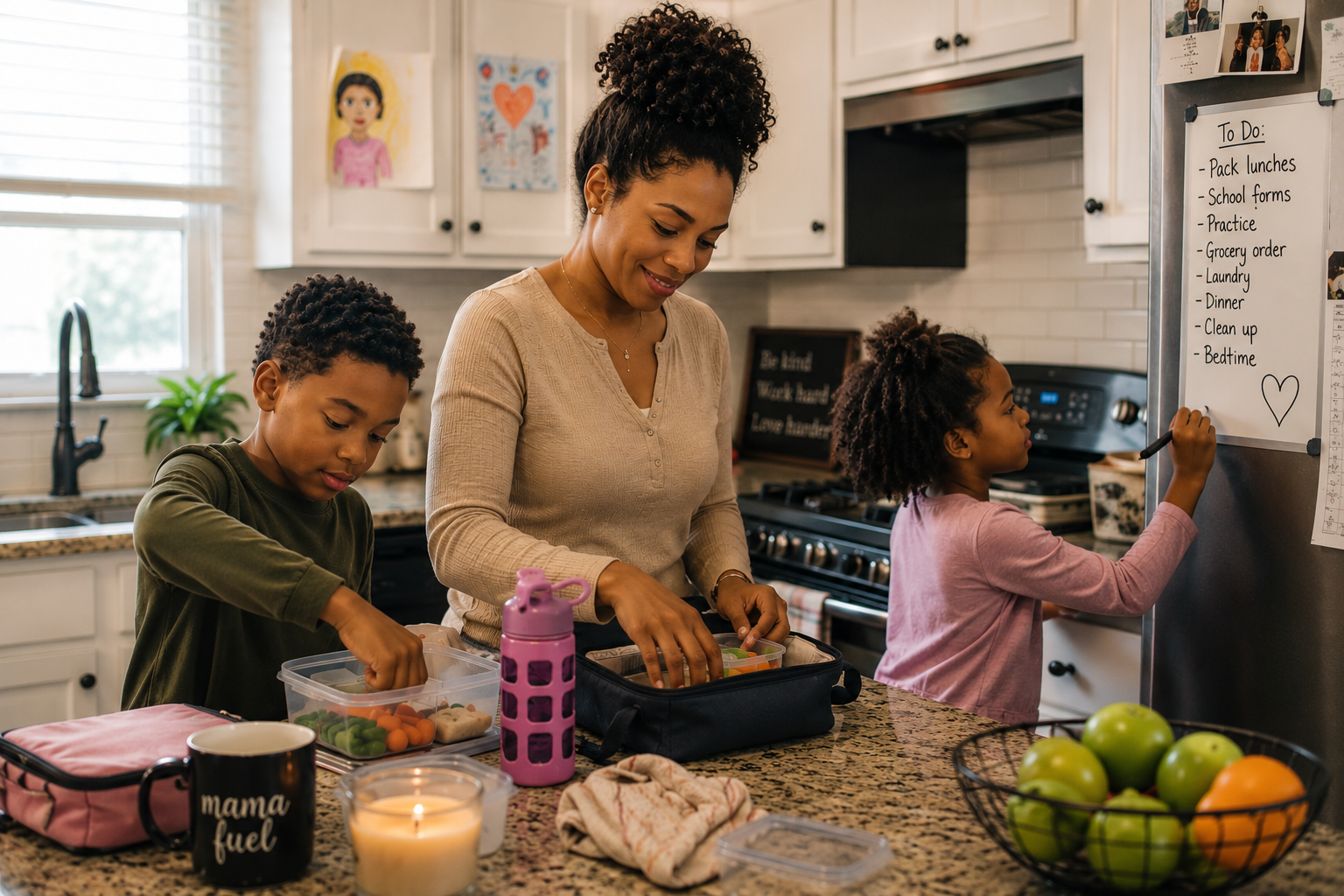
The mental load of motherhood isn't only the tasks you physically complete.
It's remembering that the task exists in the first place.
It's noticing the toothpaste is almost gone.
Remembering the permission slip.
Knowing which child suddenly refuses the lunch they happily ate last week.
Keeping track of when the school project is due.
Realizing the shoes are getting too small.
Scheduling the dentist.
Wondering whether that cough sounds worse.
Buying the birthday gift.
Remembering that your child has been unusually quiet lately.
Thinking about whether everyone has clean clothes for tomorrow.
Planning dinner while you're making lunch.
Responding to work messages while mentally calculating how long it will take to get everyone out the door.
And even when you're technically “resting,” your brain may still be working.
Did I reply to that teacher?
We need more milk.
I should schedule that appointment.
Was I too hard on her earlier?
He seemed upset after school. I need to check in.
What are we doing this weekend?
I haven't spent enough one-on-one time with them lately.
You can be sitting on the couch and still feel like you're on duty.
That kind of mental responsibility adds up.
And when you're carrying too much for too long, exhaustion can begin to change the way you see yourself.
You may interpret irritability as a character flaw instead of a sign that you're depleted.
You may interpret needing space as selfishness instead of a normal human need.
You may interpret struggling to stay present as proof you're a bad mom instead of noticing that your mind has been responsible for remembering approximately 4,000 things since breakfast.
Sometimes the question isn't:
“Why can't I handle motherhood better?”
Sometimes it's:
“How much am I trying to handle?”

Why Do I Feel Guilty When I Take Time for Myself?
For many mothers, the guilt doesn't stop when they finally get a break.
Sometimes it gets louder.
You finally have an hour to yourself, and you're thinking about what you should be doing.
You go out with friends and wonder whether you should be home.
You take a nap and wake up feeling guilty because there was laundry.
You sit down while your children are occupied and think:
I should be playing with them.
You work and worry you're not present enough at home.
You stay home and worry you're not accomplishing enough outside of it.
You want time alone, and then question what it says about you that you want to be away from the people you love most.
This is one of motherhood's most exhausting double binds:
You are encouraged to take care of yourself, but you may have learned that a “good mom” puts herself last.
So even self-care can start feeling like another thing you're doing wrong.
But needing time away from caregiving does not mean you don't enjoy being a mother.
It means caregiving requires energy.
Emotional availability requires energy.
Patience requires energy.
Listening requires energy.
Regulating yourself while helping another human regulate themselves requires a tremendous amount of energy.
And nobody has an unlimited supply.
The goal isn't to become a mother who never needs a break.
It's to begin questioning why needing one has become evidence that you're doing something wrong.
“But Other Moms Seem to Handle It Better Than I Do”
You see the mom at school who always seems calm.
The mom whose children have coordinated outfits in the family photos.
The mom making homemade snacks.
The mom who apparently remembers every themed school day.
The mom posting pictures from the pumpkin patch while you're wondering whether cereal counts as dinner.
And even when you know intellectually that social media isn't real life, comparison can still sneak in.
Because you're comparing what you know about yourself to what you can see of someone else.
You know every time you've lost patience.
Every frozen pizza.
Every forgotten form.
Every morning you turned on a cartoon because you simply needed twenty quiet minutes.
Every moment you wished someone else would take over.
You don't know those things about her.
You see her highlight reel while living inside your own unedited footage.
And when you're already worried that you're not doing enough, your brain becomes very good at finding mothers who appear to be doing it better.
What you don't see is the mother who looks completely composed at school drop-off and cried in the car ten minutes earlier.
The mother posting the beautiful family photo who yelled at everyone while trying to get out the door.
The mother who seems endlessly patient but privately worries that she's failing too.
There are mothers all around you asking themselves some version of the same question:
Am I doing this right?
Sometimes “I’m a Bad Mom” Is Anxiety Talking
Anxiety in motherhood doesn't always look like panic attacks or obvious fear.
Sometimes it looks like constant mental checking.
Is my child okay?
Am I doing enough?
Did I respond correctly?
Should I have handled that differently?
What if this affects them later?
You may replay conversations with your child after they're over.
Research parenting decisions long after you already made them.
Ask your partner whether they think you're doing a good job.
Search online to figure out whether what you're experiencing is normal.
Read parenting advice that initially makes you feel better—and then leaves you with six new things to worry about.
You may constantly look for reassurance that you're doing motherhood correctly.
And the reassurance works.
For a little while.
Then something else happens, and the doubt comes back.
This is one reason motherhood anxiety can be so exhausting. You're not only parenting your child.
You're constantly evaluating your parenting while you're doing it.
Instead of simply experiencing:
That was a hard morning.
your mind turns it into:
What does that hard morning say about me as a mother?
Instead of:
My child is struggling right now.
it becomes:
What did I do wrong?
Instead of:
I need a break.
it becomes:
Why can't I handle this?
The event itself may be difficult.
But the judgment you attach to it can make it much heavier.
Good Mothers Can Still Feel Overwhelmed, Angry, Touched Out, or Exhausted
There are feelings mothers don't always feel comfortable admitting.
Sometimes you don't want anyone touching you.
Sometimes the sound of “Mom!” makes your whole body tense.
Sometimes you are so tired of answering questions that one more “Why?” feels impossible.
Sometimes you don't want to play.
Sometimes you're irritated.
Sometimes you're bored.
Sometimes you're angry.
Sometimes you miss who you were before so many people needed something from you.
Sometimes you love your family and still fantasize about checking into a hotel room alone, ordering takeout, and hearing absolutely nobody call your name.
And then comes the guilt.
Because you think a good mom shouldn't feel that way.
But motherhood doesn't remove the parts of you that are human.
You still have limits.
You still need quiet.
You still need autonomy.
You still need adult connection.
You still need sleep.
You still need parts of your life that belong to you.
Having those needs doesn't make you less devoted to your children.
The problem often isn't the feeling itself.
It's the meaning you've learned to attach to having it.
What If the Problem Isn’t That You’re Not a Good Mom?
What if the problem is that you've created a definition of “good mom” that no actual person could consistently live up to?
What if you're using your worst moments to judge your entire relationship with your children?
What if you're expecting yourself to parent well without accounting for exhaustion, work, relationships, your own history, financial stress, lack of support, hormones, overstimulation, or the hundreds of decisions you're making every day?
What if you've become so accustomed to noticing what you could do better that you've stopped noticing everything you're already doing?
And what if the fact that you worry this much about being a good mother tells us something too?
Not that every parenting choice is perfect.
Not that there aren't things you may want to change.
Not that guilt should simply be dismissed.
But perhaps the question isn't really:
“Am I a good mom?”
Perhaps a more useful question is:
“What have I been taught a good mom is supposed to be, and is that expectation allowing me to be human?”
Because sometimes healing mom guilt isn't about becoming a better mother.
Sometimes it's about learning to stop requiring perfection from the mother you already are.
And that can be harder than it sounds.
Especially when the pressure to get motherhood right didn't begin when you had children.
Sometimes it began much earlier.
In the expectations you grew up with.
In the way love, responsibility, and achievement were modeled in your family.
In the role you learned to play long before anyone started calling you “Mom.”
And understanding that can change the way you see your struggles with motherhood entirely.

Maybe You Were Hard on Yourself Long Before You Became a Mom
For some women, motherhood doesn't create the feeling of not being good enough.
It gives that feeling a new place to land.
Maybe you've always expected a lot from yourself.
You were the responsible one.
The dependable one.
The person who got things done.
You learned to prepare, anticipate, achieve, and handle things.
Maybe people praised you for being mature, independent, successful, helpful, or “having it all together.”
You became good at noticing what needed to happen and making sure it happened.
And for a long time, that may have worked.
If you studied harder, you could improve your grade.
If you worked harder, you could get the promotion.
If you planned carefully enough, you could usually make things go relatively well.
Then you became a mother.
And motherhood does not cooperate with perfectionism.
Children have feelings you cannot prevent.
They struggle even when you make thoughtful choices.
They melt down in public.
They don't sleep because you carefully followed the bedtime routine.
They refuse the meal you spent forty-five minutes preparing and ask for crackers six minutes later.
They get hurt.
They make mistakes.
They go through stages you cannot organize your way out of.
And sometimes they are unhappy with you precisely because you're doing your job as their parent.
For someone who has spent much of her life believing that effort leads to good outcomes, this can be incredibly uncomfortable.
Because you can try very hard and still have a hard day.
You can read the books, listen to the podcasts, follow the parenting accounts, choose your words carefully, and still have a child slam a door and tell you you're the worst mom ever.
You can do everything “right” and still have a child who struggles.
And if your brain has learned to interpret struggle as failure, you may automatically conclude:
I must be doing something wrong.
Perfectionism Can Make Good-Enough Motherhood Feel Like Failure
Perfectionism in motherhood isn't always obvious.
You don't necessarily think:
I must be a perfect mother.
It may sound more reasonable than that.
I just want to do what's best for my kids.
I want them to have a good childhood.
I don't want to mess them up.
I want to break unhealthy patterns.
I know how important these years are.
Those desires can come from a deeply loving place.
But when love becomes tangled with fear, motherhood can begin to feel like a test you cannot afford to fail.
You may feel responsible not only for caring for your children, but for ensuring that they grow up happy, emotionally healthy, confident, secure, successful, kind, resilient, and somehow untouched by the fact that their parents are human.
Every parenting decision starts to feel loaded.
Should you have comforted them longer?
Were you too permissive?
Too strict?
Did you validate enough?
Did you set the boundary correctly?
Should you have handled the tantrum differently?
Are you giving them enough independence?
Enough attention?
Enough one-on-one time?
Enough structure?
Enough freedom?
The pressure can become enormous because there is always another way you could theoretically improve.
And if your standard is:
“A good mom always responds the right way,”
you will fail that standard.
Not because you're a bad mother.
Because you're a person.
Children don't need parents who never make mistakes.
They need relationships where mistakes can be acknowledged, repaired, and survived.
That difference matters.
You Can Be Intentional About Breaking Generational Patterns and Still Make Mistakes
Maybe you're especially hard on yourself because you want your children's childhood to feel different from yours.
You want them to feel heard.
Safe.
Accepted.
Comfortable talking to you.
You don't want them walking on eggshells.
You don't want them believing love has to be earned.
You don't want them afraid to make mistakes.
You don't want to repeat the things that hurt you.
So when you recognize even a glimpse of something familiar in yourself, it can feel terrifying.
Maybe you hear yourself yell and suddenly think of your own parent.
Maybe you dismiss your child's feelings and realize later that this is exactly what happened to you.
Maybe you become controlling when you're anxious.
Maybe you shut down during conflict.
Maybe you notice yourself saying something you swore you'd never say.
The reaction can be immediate:
Oh my God. I'm becoming my mother.
Or:
I'm doing the same thing that was done to me.
But breaking generational patterns doesn't mean you will never repeat a behavior you grew up with.
It means you develop the awareness and capacity to respond differently over time.
Sometimes that means catching yourself before you react.
Sometimes it means catching yourself halfway through.
And sometimes it means realizing afterward:
That wasn't how I wanted to handle that.
Then going back.
Repairing.
Apologizing.
Trying again.
Cycle-breaking is rarely a clean line between “what my parents did” and “what I do.”
It is often messy, imperfect, emotional work.
And sometimes the very determination to give your children something different can become another impossible standard you hold yourself to.
“I Don’t Want My Kids to Need Therapy Because of Me”
Many mothers have thought some version of this.
Sometimes jokingly.
Sometimes with genuine fear.
You may believe that if you parent carefully enough, your children will never have emotional wounds connected to you.
But no parent can guarantee a childhood without hurt, misunderstanding, disappointment, conflict, or unmet needs.
You will misunderstand your child sometimes.
You will be distracted when they want your attention.
You will make a parenting decision they disagree with.
There will be moments when you don't recognize what they need until later.
Your child may grow up and remember an event completely differently than you do.
That isn't evidence that the relationship failed.
Healthy relationships are not relationships without rupture.
They are relationships where there is room for repair.
A child can learn something enormously valuable from experiencing:
Mom got frustrated.
Mom calmed down.
Mom came back.
Mom listened.
Mom said she was sorry.
We were okay.
Repair teaches children that conflict does not automatically mean abandonment.
That people can take responsibility.
That love can survive uncomfortable emotions.
That relationships don't require perfection to be safe.
And perhaps just as importantly, it teaches them that being a good person doesn't mean never getting something wrong.
Imagine what it could mean for your child to learn that lesson by watching you.
If You Grew Up Taking Care of Everyone Else, Motherhood Can Feel Especially Heavy
Some mothers learned very early to pay attention to other people's needs.
Maybe you were the helper in your family.
The peacekeeper.
The oldest daughter.
The easy child.
The mature one.
The one who didn't cause problems.
You learned to read the room.
You knew when someone was upset before they said anything.
You learned when to stay quiet.
When to help.
When not to ask for too much.
Perhaps being responsible earned praise.
Perhaps being low-maintenance kept things peaceful.
Perhaps taking care of other people became such a normal part of your identity that you barely noticed you were doing it.
Then motherhood arrives and reinforces the same message:
Everyone needs you.
And you know how to be needed.
You can anticipate.
Organize.
Soothe.
Remember.
Fix.
Carry.
So you do.
Until one day you realize you are exhausted—and somehow still feel guilty that you're not doing enough.
This can be especially confusing because being needed may feel both meaningful and suffocating.
You love taking care of your family.
And sometimes you desperately want someone to take care of you.
Both can be true.
People-Pleasing Doesn’t Disappear When You Become a Mom
People-pleasing can simply take a different shape in motherhood.
Now you're not only worried about disappointing other adults.
You may be terrified of disappointing your children.
You want them to be happy.
You want them to feel loved.
You don't want them angry with you.
You don't want to say no and watch their face fall.
So maybe you over-explain your boundaries.
Change your mind after pushback.
Do things for them you don't actually have the energy to do.
Say yes to another activity when your calendar is already overwhelming.
Agree to host.
Volunteer.
Buy the thing.
Stay longer.
Give one more chance.
And then you become resentful.
Which creates another layer of guilt.
Why am I irritated? They're just kids.
But resentment is often information.
It can be a sign that your limits have been crossed repeatedly—even when you were the one crossing them.
Boundaries in motherhood aren't evidence that you're withholding love.
Children can be disappointed and still be loved.
They can be angry with you and still be safe with you.
They can wish your answer were different and still have a secure relationship with you.
You don't have to prevent every uncomfortable feeling your child experiences in order to be a good mom.
In fact, part of parenting is helping children learn:
I can feel disappointed and be okay.
That's difficult to teach if you're terrified of letting them feel disappointed in the first place.
Maybe You’re Not Angry at Your Kids—Maybe You’re Overloaded
You ask nicely the first time.
Then again.
Then again.
Then somehow you're standing in the kitchen hearing yourself say:
“How many times do I have to ask?”
And immediately afterward, the guilt hits.
Why did I yell?
They're just kids.
I should have been more patient.
Sometimes, yes, there are skills that can help you respond differently.
But it's also worth asking what happened during the twelve hours before that moment.
How many decisions had you made?
How many people needed something from you?
Had you eaten?
Had you slept?
Had you had five uninterrupted minutes?
Were you trying to finish work while someone asked for a snack, another child couldn't find something, the dog needed to go out, and your phone was buzzing?
Had you already repeated yourself fourteen times that day?
Were you carrying something emotionally that nobody else knew about?
Because anger doesn't happen in a vacuum.
Sometimes what looks like an “anger problem” is a nervous system that has been operating beyond capacity.
That doesn't mean yelling doesn't matter.
It means shame may not be the most useful response.
Understanding what leads up to the moment gives you far more power to change it than simply telling yourself:
Be more patient.
“Why Am I So Irritable With My Kids?”
Irritability with your children can happen for many reasons, including stress, anxiety, lack of sleep, overstimulation, burnout, resentment, hormonal changes, or simply having too little time to recover between demands.
Sometimes the trigger is tiny because the load underneath it isn't.
Your child spills milk.
And your reaction feels wildly disproportionate to spilled milk.
But maybe it wasn't really about the milk.
It was about the milk after the argument with your partner.
After the difficult workday.
After being woken up twice.
After nobody noticed you already cleaned the kitchen.
After you've been trying to remember something important for three days.
The spill is simply the thing that lands on top of everything else.
And when that happens repeatedly, you may start thinking:
I don't like who I am as a mom.
But before turning irritability into an identity, it can help to get curious about what your irritability is telling you.
Are you getting enough support?
Are you constantly overstimulated?
Are you carrying responsibilities that could be shared?
Do you ever get to stop being responsible for someone?
Are you trying to meet expectations that aren't realistic for your actual life?
Sometimes you don't need to become infinitely more patient.
Sometimes something about the load needs to change.
Resentment in Motherhood Can Feel Especially Shameful
This is another feeling mothers don't always talk about.
Resentment.
Maybe you're resentful that you're the one who always knows.
Where the shoes are.
What time the appointment is.
When the school form is due.
What groceries you need.
Which child needs new clothes.
What everyone is doing this weekend.
Maybe your partner helps when asked, but you're tired of being the one who has to ask.
Because asking is another task.
You don't just want help completing the list.
You want someone else to notice that a list exists.
Or maybe your resentment isn't directed toward a partner.
Maybe it's toward motherhood itself.
The constant demands.
The lack of privacy.
The interruption.
The way your time no longer feels entirely yours.
The pressure to appreciate every minute of something that can also be relentless.
Then the guilt appears:
I wanted these children.
I love them.
Other people would give anything to have what I have.
I should be grateful.
Gratitude and resentment can exist together.
You can deeply love your life and still recognize that parts of it are hard.
You can adore your children and dislike certain parts of parenting.
You can appreciate your family and still need something to change.
Suppressing resentment doesn't necessarily make it disappear.
Sometimes it simply comes out somewhere else, as irritability, disconnection, exhaustion, or another round of self-criticism.
Why Do I Feel Like I Lost Myself After Becoming a Mom?
Sometimes “I don't feel like a good mom” is connected to another question:
“I don't know who I am anymore.”
Before motherhood, there were parts of you that had nothing to do with taking care of someone else.
Your interests.
Friendships.
Career.
Spontaneity.
Body.
Time.
Goals.
Relationships.
The way you spent a Saturday morning.
Even the ability to leave the house without mentally accounting for another person's snacks, clothes, bathroom needs, nap schedule, and emotional state.
Motherhood can change your identity in profound ways.
And while some of those changes may feel beautiful, others can involve grief.
You can love who you became and still miss who you were.
You can feel grateful for your children and still miss freedom.
You can enjoy being needed and also want to be known for something other than what you provide for everyone else.
That doesn't make you selfish.
Identity doesn't disappear when you become a mother.
But sometimes it gets buried underneath responsibility.
And when every part of your life begins revolving around what other people need from you, you may eventually feel disconnected from yourself.
Then you may try to solve that disconnection by becoming even better at motherhood.
More activities.
More memories.
More effort.
More giving.
When what you actually miss is you.
Postpartum Changes Don’t Always End After the Newborn Stage
When people hear the word postpartum, they often picture the first few weeks or months after having a baby.
But the emotional transition into motherhood doesn't follow a neat timeline.
Maybe your baby isn't a newborn anymore.
Maybe your children are toddlers.
In elementary school.
Maybe you've been a mother for years.
And you're only now beginning to recognize how much changed.
Pregnancy and motherhood can affect your relationship with your body, identity, career, partner, friendships, family, independence, sexuality, sleep, and sense of control.
Sometimes there isn't space to process any of that when you're in survival mode.
You're feeding.
Changing.
Working.
Recovering.
Trying to sleep.
Trying to keep another human alive.
Then the immediate crisis settles.
And suddenly there's enough quiet to realize:
I'm not sure I feel like myself.
For some mothers, persistent guilt, worry, irritability, sadness, intrusive thoughts, disconnection, or feeling unable to relax may also be connected to postpartum anxiety or depression.
These experiences don't always look the way people expect.
A struggling mother may still go to work.
Smile.
Take pictures.
Care beautifully for her baby.
Show up for everyone.
And privately feel like she's barely holding herself together.
Black Mothers Can Carry Additional Expectations Around Strength
For some Black mothers, motherhood exists alongside another expectation:
Be strong.
Handle it.
Keep going.
Take care of your family.
Don't let things fall apart.
Strength can be a source of pride, survival, connection, and resilience.
But when strength becomes the only version of yourself you feel permitted to show, it can also become exhausting.
You may be the person everyone relies on while quietly wondering who you are allowed to rely on.
You may feel pressure to protect your children from experiences you know they may face in the world while also creating a home where they can feel safe, confident, and free to be themselves.
You may carry worries that other mothers don't have to think about in quite the same way.
And asking for help can feel uncomfortable when you've spent years being praised for how much you can handle.
But strength doesn't have to mean carrying everything alone.
Sometimes strength looks like recognizing:
This is a lot.
I need support too.
Your Relationship With Your Own Mother May Show Up More After You Have Children
Motherhood has a way of bringing old memories to the surface.
You may suddenly understand your mother differently.
You may appreciate things she did that you couldn't understand before.
Or you may become more confused.
Because now you look at your own child and think:
How could she have said that to me?
How could she not have noticed?
Why wasn't I comforted like this?
Parenting your child can sometimes put you face-to-face with the child you once were.
You give your daughter reassurance and realize how badly you needed reassurance too.
You apologize to your son and realize you rarely heard apologies growing up.
You encourage your child to rest and suddenly notice how early you learned that your value came from accomplishing things.
You tell your child:
“You don't have to be perfect.”
And somewhere inside, another part of you wonders:
Then why have I spent my whole life believing that I do?
This can bring grief.
Anger.
Compassion.
Confusion.
Sometimes all of them at once.
And it can make motherhood feel emotionally heavier than the daily tasks alone would suggest.
Because you're not only raising your children.
Sometimes you're confronting your own childhood while you do it.
You May Be Trying to Give Your Children What You Needed
This can be beautiful.
It can also become exhausting.
Maybe you didn't feel heard growing up, so you work incredibly hard to listen.
Maybe your emotions weren't welcomed, so you want your children to know every feeling is okay.
Maybe achievement received more attention than emotional needs, so you're determined not to make your children feel they have to earn your approval.
Maybe there wasn't much affection.
Or consistency.
Or emotional safety.
So you are trying very intentionally to create those things now.
But sometimes the determination to give your children everything you needed turns into another kind of pressure.
You may believe you have to get every interaction right because you know what it feels like when parents get things wrong.
Your own pain can make the stakes feel enormous.
And when you make a mistake, you aren't only responding to what happened today.
You may be responding to what that mistake represents to you.
What if I'm repeating the cycle?
What if they feel the way I felt?
What if I'm hurting them without realizing it?
That's a much heavier burden than:
I had a rough parenting moment today.
And it may explain why a relatively ordinary mistake can send you into hours of guilt.
Sometimes Your Guilt Is Trying to Tell You Something, and Sometimes It Isn’t
Not all mom guilt is useless.
Sometimes guilt can tell us:
That wasn't how I wanted to respond.
I need to apologize.
I've been distracted lately and want to reconnect.
Something needs to change.
Healthy guilt can point toward your values.
It can help you repair.
Then, ideally, it lets you move forward.
But there is another kind of guilt that doesn't seem interested in helping you do anything differently.
It simply says:
You're not enough.
You apologize, and it says you shouldn't have made the mistake.
You spend time with your children, and it says it wasn't enough.
You rest, and it says you're lazy.
You work, and it says you're absent.
You stay home, and it finds something else you're failing at.
You make a thoughtful parenting decision, and it asks whether another decision would have been better.
There is no finish line.
That's when guilt stops functioning as useful information and starts functioning more like self-punishment.
And self-punishment rarely makes parenting easier.
It usually makes an already tired mother even more exhausted.
The Question Beneath “Am I a Good Mom?” May Be Something Else Entirely
After a while, it can be worth getting curious about what you're actually asking when you ask:
“Am I a good mom?”
Maybe you're asking:
“Are my kids going to be okay?”
Maybe:
“Can I make mistakes and still be loved?”
Or:
“Am I allowed to have needs too?”
“Can my child be unhappy with me without it meaning I've failed?”
“Can I parent differently without knowing exactly what I'm doing?”
“Can I trust myself?”
“Can I stop trying so hard without everything falling apart?”
Those questions go much deeper than parenting tips.
And that may be why another article telling you to “give yourself grace” doesn't always help.
Because perhaps you've already tried giving yourself grace.
You've told yourself nobody is perfect.
You've saved the inspirational posts.
You've promised yourself you'd stop being so hard on yourself.
And then the next difficult parenting moment happens.
The guilt comes rushing back.
Because changing how you feel about yourself as a mother often requires more than simply knowing, intellectually, that perfection isn't possible.
It can mean understanding why your mind believes perfection is necessary in the first place.
And then slowly building a different way of relating to yourself, your children, and the inevitable imperfect moments that come with loving them.
So if you've been asking:
Why don't I feel like a good mom?
Maybe the answer isn't that you need to try harder.
Maybe you've been trying hard enough for a very long time.
The next step may be learning what it would look like to mother your children without constantly putting yourself on trial.
And that is something you can begin to change.

How Do I Stop Feeling Like I’m Failing as a Mom?
You probably don't need another person telling you to “give yourself grace.”
You may already know you're supposed to be kinder to yourself.
You may have told yourself:
I'm doing my best.
No mom is perfect.
My kids know I love them.
And maybe you believe those things for a few minutes.
Then something happens.
You lose your patience.
You forget something.
Your child has a meltdown.
You see another mom doing something you aren't doing.
And suddenly you're right back in the familiar place:
I'm not doing enough.
That's because changing mom guilt usually takes more than replacing one negative thought with a positive one.
It means becoming curious about the rules you've been using to decide whether you're a good mother in the first place.
Some of those rules may have been with you for years.
And you may never have consciously chosen them.
Start by Asking: What Does “A Good Mom” Mean to Me?
Try finishing this sentence without overthinking it:
A good mom should __________.
Maybe your answers sound like:
Never lose her temper.
Always put her children first.
Enjoy spending time with her kids.
Keep everyone organized.
Make healthy meals.
Be emotionally available.
Know when something is wrong.
Be involved at school.
Have a close relationship with her children.
Work hard.
Keep the house reasonably clean.
Make childhood special.
Be patient.
Never make her children feel the way she felt growing up.
Now look at your list.
How many of those expectations could any human being meet consistently?
And where did they come from?
Your family?
Your culture?
Social media?
Your own childhood?
Other mothers?
Parenting experts?
The version of motherhood you imagined before you actually had children?
Sometimes we spend years trying to satisfy expectations we've never stopped to evaluate.
A more helpful question might be:
What actually matters most to me as a mother?
Not what Instagram says should matter.
Not what your mother-in-law thinks.
Not what the mom at school appears to be doing.
Not what the parenting book says you should execute flawlessly.
What do you want your children to experience in their relationship with you?
Maybe you want them to know:
I am loved.
I can come to my mom when something is wrong.
I don't have to be perfect.
My feelings matter.
Our home is safe.
We can laugh together.
We can disagree and reconnect.
My mom is interested in who I am.
Those values offer a much more useful compass than perfection ever could.
Stop Asking Whether the Moment Was Perfect…and Ask Whether the Relationship Is Safe Enough for Repair
Imagine this:
It's bedtime.
You're exhausted.
Your child is moving at approximately one-quarter the speed required to get into bed before midnight.
You've asked three times.
Then four.
Finally, you snap:
“Can you PLEASE just get your pajamas on?”
Your child gets quiet.
And there it is.
That feeling in your stomach.
I did it again.
You could spend the next two hours criticizing yourself.
Or you could return to your child and say something like:
“I was frustrated, but I shouldn't have yelled at you. I'm sorry. Let's try that again.”
That moment may not look like perfect parenting.
But it can still be healthy parenting.
Your child learns:
Mom has emotions.
Mom can make mistakes.
Mom takes responsibility for them.
My feelings matter.
Conflict doesn't mean our relationship disappears.
We can reconnect.
Children do not need mothers who flawlessly regulate every emotion.
They benefit from relationships where rupture is followed by repair.
And the ability to repair may be far more useful—for you and your children—than expecting yourself never to get anything wrong.
What to Do After You Yell at Your Kids
If you yell at your child, shame usually makes the moment harder.
Instead of spending the rest of the day thinking:
I'm a terrible mom.
try separating what you did from who you are.
You can say:
“I don't like how I handled that.”
That's very different from:
“I'm a bad mother.”
One describes behavior.
The other turns one behavior into an identity.
From there, ask yourself:
What was happening inside me before I yelled?
Was I overwhelmed?
Rushing?
Hungry?
Trying to do three things at once?
Had I repeated myself multiple times?
Was there something else bothering me?
What could I do differently next time?
And then, when appropriate, repair with your child.
You don't need an elaborate speech.
You can keep it simple:
“I got frustrated and yelled. That wasn't the way I wanted to talk to you. I'm sorry.”
Notice what isn't included:
“But you weren't listening.”
Repair doesn't require pretending the child's behavior wasn't frustrating.
It simply means taking responsibility for your part.
Then you move forward.
You do not have to punish yourself for the rest of the day to prove that you care.
Learn the Difference Between Responsibility and Self-Punishment
This distinction can change motherhood.
Responsibility says:
I don't like how I handled that. What can I learn from it?
Self-punishment says:
What's wrong with me?
Responsibility says:
I need to apologize.
Self-punishment says:
I can't believe I did that. A good mother wouldn't have.
Responsibility creates movement.
Self-punishment keeps you stuck.
And sometimes mothers confuse self-criticism with accountability.
You may worry that if you stop being hard on yourself, you'll stop trying to be a good mom.
But think about how you teach your children.
When they make a mistake, do you want them to spend the next three days telling themselves they're terrible?
Probably not.
You want them to recognize what happened, make amends when necessary, learn something, and keep growing.
You're allowed to approach your own mistakes the same way.
Pay Attention to What Happens Before You Reach Your Breaking Point
Many mothers focus almost entirely on the moment they lose patience.
But the more useful information may come from the twenty moments before it.
Maybe your breaking point happens most often:
At bedtime.
During the morning rush.
When everyone talks to you at once.
When you've gone too long without eating.
After a stressful workday.
When the house feels chaotic.
When your partner is unavailable.
When one child is whining while another is asking for something.
When you've had no time alone.
When you've been trying to hold in frustration all day.
Start noticing the pattern.
Not because you're trying to diagnose every emotion.
Because patterns give you something you can actually work with.
Instead of:
“Why am I such an impatient mom?”
you may discover:
“I'm much more likely to lose my patience when I'm overstimulated and trying to get everyone out of the house.”
That is actionable.
Maybe mornings need fewer decisions.
Maybe clothes need to be chosen the night before.
Maybe another adult needs to take ownership of part of the routine.
Maybe you need ten quiet minutes after work before immediately stepping into the next shift.
You cannot eliminate every stressful moment.
But you can stop treating your reactions as mysterious character defects and begin understanding the conditions that make them more likely.
Sometimes You Need More Than Better Coping Skills. You Need More Support.
This matters.
Because sometimes women are encouraged to cope with situations that actually need to change.
Meditate.
Practice gratitude.
Take a bath.
Use deep breathing.
Buy a planner.
Wake up earlier.
Meanwhile, you're still responsible for everything.
You are still the one remembering every appointment.
Planning every meal.
Managing every school deadline.
Scheduling everything.
Anticipating everyone's needs.
Being the default parent.
And then you're wondering why mindfulness hasn't fixed your irritability.
Coping skills can be helpful.
But they cannot make an unsustainable workload sustainable forever.
Sometimes the question isn't:
“How can I handle more?”
It's:
“What shouldn't I have to handle alone?”
That may mean having a more direct conversation with your partner.
Sharing ownership of entire responsibilities instead of delegating individual tasks.
Saying no to something.
Reducing commitments.
Asking family for help.
Hiring support when that's financially possible.
Letting something be done differently than you would do it.
Allowing some things not to get done at all.
For a mother who is accustomed to being capable, responsible, and dependable, receiving help can feel surprisingly uncomfortable.
But needing help isn't evidence that you're incapable.
Motherhood was never meant to be an individual endurance test.
Let Some Things Be “Good Enough”
This might be harder than it sounds.
Especially if part of you believes:
If I don't do it, it won't get done right.
There will be seasons when dinner is homemade and seasons when dinner comes out of a box.
Some birthdays will have elaborate themes.
Some will not.
Sometimes you'll be fully present on the floor playing.
Sometimes you'll say:
“Mom needs ten minutes.”
Sometimes you'll remember spirit day.
Sometimes your child will arrive at school without the required neon green hat because the email disappeared into the black hole of 47 other school emails.
Your child's childhood is not being built out of isolated moments of perfect execution.
It's being built through thousands of ordinary interactions.
Breakfasts.
Car rides.
Inside jokes.
Arguments.
Hugs.
Mistakes.
Bedtime conversations.
Showing up.
Coming back.
Knowing they belong.
The ordinary matters more than motherhood culture sometimes leads us to believe.

Make Room for a Version of You Who Isn't “Mom”
Ask yourself:
What did I enjoy before everyone needed something from me?
You may know immediately.
Or the question may make you strangely sad.
Maybe you don't know anymore.
That doesn't mean you've lost yourself permanently.
It may simply mean parts of you haven't had much space lately.
Maybe you used to read.
Exercise.
Paint.
Travel.
Go out with friends.
Sit somewhere quietly drinking coffee.
Listen to music you actually chose.
Take long showers without someone opening the door.
Have conversations that weren't about schedules, school, or children.
You don't need to reclaim your entire pre-motherhood identity.
You're not the same person anymore.
But being a mother doesn't require reducing your identity to motherhood alone.
Your children benefit from knowing you as a whole person.
A person with friendships.
Interests.
Boundaries.
Needs.
Joy.
Rest.
Goals.
You are allowed to have a life that includes them deeply without being entirely consumed by them.
You Don't Have to Enjoy Every Minute to Be Grateful for Your Life
“Enjoy every minute. It goes so fast.”
Most mothers have heard some version of this.
Usually from someone who means well.
But it can create an enormous amount of pressure.
Because you are aware that your children are growing.
You know this stage won't last.
And somehow that makes it feel even worse when you aren't enjoying it.
But you don't have to cherish tantrums.
You don't have to savor sleep deprivation.
You don't have to feel grateful while cleaning something mysterious off the carpet.
You don't need to transform every exhausting parenting moment into a treasured memory.
Some moments are beautiful.
Some are boring.
Some are hilarious.
Some are exhausting.
Some you will miss terribly.
Some you will be delighted never to experience again.
That's not ingratitude.
That's life.
You can know something is temporary without enjoying every second of it.
What Does Being a “Good Enough” Mom Actually Look Like?
A good-enough mom isn't perfect.
She gets tired.
She becomes frustrated.
She misreads situations.
She occasionally says the wrong thing.
She has limits.
She needs breaks.
She doesn't always know what to do.
But she keeps showing up.
She notices.
She learns.
She repairs.
She adjusts.
She loves.
She tries again.
She allows her children to know that adults are human too.
And perhaps most importantly, she begins accepting that her children do not need a flawless mother.
They need her.
Not the imaginary version of her who is endlessly patient, always available, perfectly regulated, beautifully organized, completely selfless, and somehow also well-rested.
The actual her.
Human.
Imperfect.
Present enough.
Loving.
Repairing.
Growing alongside them.
When Mom Guilt May Be Something More
Most mothers experience guilt, frustration, self-doubt, or overwhelm at times.
But sometimes the intensity or persistence of what you're feeling may signal that you deserve more support.
You might notice that you:
Feel anxious much of the time.
Can't turn your mind off, even when nothing is immediately wrong.
Frequently imagine worst-case scenarios involving your children.
Constantly need reassurance that you're parenting correctly.
Feel chronically overwhelmed or unable to relax.
Experience intense irritability or anger that feels difficult to control.
Feel disconnected from yourself or your family.
Feel numb or like you're going through the motions.
Cry frequently.
Feel hopeless.
No longer enjoy things you normally enjoy.
Feel intense guilt or worthlessness.
Have intrusive thoughts that frighten you.
Feel as though you're carrying more than you can continue carrying.
Sometimes these experiences can be related to anxiety, depression, parental burnout, postpartum anxiety, postpartum depression, trauma, chronic stress, or another mental health concern.
You don't need to determine exactly what label fits before reaching out for support.
And you don't have to wait until everything feels unbearable.
How Therapy Can Help When You Never Feel Good Enough as a Mom
Therapy for overwhelmed moms isn't about teaching you how to be a better mother.
You may already be spending more than enough energy trying to improve yourself.
Instead, therapy can create space to understand what's happening underneath the pressure.
Maybe you're carrying anxiety that has become so constant you barely recognize it as anxiety anymore.
Maybe motherhood activated old perfectionistic patterns.
Maybe you're trying to parent differently from how you were raised and discovering how complicated that can be.
Maybe resentment has been building because you carry most of the mental load.
Maybe you have difficulty asking for help.
Maybe you've lost touch with yourself.
Maybe you understand everyone's needs except your own.
Maybe you're exhausted from being the one who always holds everything together.
Therapy can help you notice these patterns without immediately judging yourself for having them.
It can also help you learn how to:
Recognize anxiety before it takes over.
Respond differently to perfectionistic thoughts.
Set boundaries without drowning in guilt.
Regulate yourself when you're overwhelmed.
Understand triggers connected to your own childhood.
Repair with your children without spiraling into shame.
Communicate more directly about what you need.
Create a more realistic division of the mental load.
Reconnect with parts of yourself outside motherhood.
Trust yourself more.
And begin treating yourself with some of the same patience you work so hard to give your children.
Therapy for Moms in Chicago and Throughout Illinois
If you've been searching for therapy because you feel overwhelmed, anxious, guilty, burned out, or simply unlike yourself in motherhood, you don't have to wait until things become worse before asking for support.
At Mindful Healing Counseling, our psychologist-led team provides online therapy for moms throughout Chicago and Illinois, including support for anxiety, motherhood overwhelm, perfectionism, people-pleasing, trauma, postpartum concerns, relationship stress, and the invisible mental load that can come with caring for everyone else.
We work with women throughout Chicago, including Hyde Park, Bronzeville, Beverly, South Shore, the West Loop, Lincoln Park, Rogers Park, and Pilsen, as well as communities throughout the Chicago suburbs, including Orland Park, Tinley Park, Homewood, Flossmoor, Oak Lawn, Palos Heights, Oak Park, Naperville, Evanston, Joliet, and beyond.
Because sessions are online, you can meet with your therapist from home without adding another drive, appointment commute, or logistical task to an already full day.
Therapy doesn't require you to arrive with a diagnosis or even know exactly what's wrong.
You can begin with:
“I love my kids. I'm just tired of feeling like I'm failing them.”
That's enough of a place to start.
Frequently Asked Questions About Mom Guilt, Feeling Like a Bad Mom & Motherhood Overwhelm
Why do I constantly feel like I'm failing as a mom?
You may constantly feel like you're failing as a mom because you're evaluating yourself against unrealistic expectations, focusing more heavily on your mistakes than your successes, carrying too much of the physical or mental load, or struggling with anxiety or perfectionism.
Many mothers unconsciously define a “good mom” as someone who is endlessly patient, emotionally available, organized, selfless, and able to meet everyone's needs without becoming overwhelmed. No one can consistently meet that standard.
Feeling like you're failing is therefore not necessarily evidence that you're actually failing. Sometimes it is evidence that your measuring stick has become impossible to satisfy.
Why do I feel like a bad mom even though I love my kids?
Loving your children and feeling confident as a mother are two different things.
You can love your kids deeply and still feel overwhelmed, irritated, exhausted, uncertain, or disconnected at times. Mom guilt, perfectionism, anxiety, comparison, childhood experiences, and unrealistic expectations can all make a caring mother believe she isn't doing enough.
The question to ask may be less:
“Do I love my kids enough?”
and more:
“Why have I learned to interpret normal struggles in motherhood as evidence that I'm a bad mom?”
Is it normal to feel like a bad mom sometimes?
Yes. Many mothers question whether they're doing a good enough job, particularly after losing patience, making a mistake, comparing themselves with other parents, or feeling overwhelmed.
Occasional self-doubt can be part of parenting.
However, if thoughts that you're a bad mother are constant, cause significant distress, interfere with your ability to enjoy your life, or are accompanied by anxiety, sadness, irritability, hopelessness, intrusive thoughts, or emotional exhaustion, additional support may be helpful.
Does feeling guilty mean I'm a bad mom?
No. Feeling guilty does not automatically mean you've done something wrong or that you're a bad mother.
Sometimes guilt is useful. It tells you that your behavior didn't align with your values and encourages you to repair or make a different choice.
But chronic mom guilt can also come from perfectionism, anxiety, unrealistic expectations, comparison, and the belief that a good mother should always put everyone else's needs before her own.
Useful guilt helps you make a change and move forward.
Unhealthy guilt keeps telling you you're not enough no matter what you do.
How do I stop feeling so much mom guilt?
Reducing mom guilt usually begins by identifying the standard you're holding yourself to.
Ask yourself:
What do I believe a good mom should do?
Then consider whether those expectations are realistic and whether they reflect your actual values or someone else's definition of motherhood.
It can also help to distinguish mistakes from identity.
Instead of:
“I'm a bad mom.”
try:
“I don't like how I handled that moment. What do I want to do differently?”
Repair what needs repairing, make changes where they are needed, and allow yourself to move forward instead of repeatedly punishing yourself for being human.
Why am I so irritable with my kids?
Irritability with your children can happen when you're stressed, sleep-deprived, overstimulated, anxious, burned out, carrying resentment, or managing more responsibilities than you have the capacity to sustain.
Sometimes a small behavior from your child becomes the final demand on top of dozens of other demands you've already managed that day.
Rather than only asking:
“Why can't I be more patient?”
it may be helpful to ask:
“What is making patience so difficult for me right now?”
Understanding the circumstances surrounding your irritability can help you identify what actually needs to change.
Why do I get so angry at my kids and then feel guilty?
You may become angry with your children when stress, sensory overload, exhaustion, repeated demands, lack of support, or unresolved emotions push you beyond your capacity.
Afterward, your values as a parent may clash with the way you reacted, creating guilt.
Instead of getting trapped in shame, look at both parts of the experience.
Take responsibility for how you responded and get curious about what contributed to reaching that point.
You can apologize to your child, repair the interaction, and also work on reducing the conditions that repeatedly push you toward your breaking point.
Did I damage my child by yelling?
An isolated moment of yelling does not by itself define your child's entire emotional experience or your relationship with them.
What matters is the larger pattern of the relationship and what happens afterward.
If you respond in a way you regret, repair can be powerful. Acknowledge what happened, take responsibility without blaming your child, apologize, reconnect, and think about what may help you respond differently next time.
If yelling is frequent, feels difficult to control, frightens you, or is part of a broader pattern of anger or overwhelm, therapy or additional parenting support may be helpful.
Why do I feel guilty taking time away from my kids?
Many mothers feel guilty taking time for themselves because they have internalized the idea that good motherhood means constant availability and self-sacrifice.
You may intellectually know you need rest while emotionally believing that choosing yourself means taking something away from your children.
But rest, relationships, interests, time alone, and other parts of your identity are legitimate needs.
Needing time away from caregiving doesn't mean you love your children less.
It means you are a person as well as a parent.
Why do I feel like I've lost myself since becoming a mom?
Motherhood can transform nearly every part of life, including your routines, body, relationships, priorities, career, freedom, friendships, and sense of identity.
When most of your time and mental energy becomes focused on other people's needs, you may gradually feel disconnected from the parts of yourself that existed outside caregiving.
Reconnecting with yourself doesn't mean returning to exactly who you were before children.
It means making room for a fuller identity in which motherhood is an important part of you without becoming all of you.
Can anxiety make me feel like a bad mom?
Yes. Anxiety can make you constantly question whether you're parenting correctly.
You may replay interactions, worry excessively about your children's wellbeing, research parenting decisions repeatedly, seek reassurance, imagine worst-case scenarios, or interpret everyday parenting mistakes as signs that you're harming your child.
Anxiety tends to focus attention on uncertainty and possible problems, which can make it difficult to recognize everything that is going well.
Therapy can help you distinguish between realistic parenting concerns and anxiety-driven doubt.
Can postpartum anxiety or depression make me feel like a bad mother?
Yes. Postpartum anxiety and depression can include intense guilt, worry, irritability, sadness, intrusive thoughts, disconnection, difficulty relaxing, feelings of inadequacy, or the sense that other mothers are handling motherhood better than you are.
Postpartum mental health struggles do not always look like constant sadness, and a mother can continue working, caring for her children, and appearing “fine” while struggling significantly inside.
If these feelings are intense, persistent, frightening, or interfering with daily life, consider speaking with a qualified mental health or healthcare professional.
How do I know whether I'm experiencing mom burnout?
Mom or parental burnout can involve emotional and physical exhaustion related to prolonged parenting stress.
You might feel chronically depleted, increasingly irritable, emotionally distant, resentful, numb, overwhelmed by ordinary demands, or like you have very little left to give.
Burnout is particularly likely when responsibilities and demands consistently exceed the support, recovery time, and resources available to you.
If you keep asking yourself why normal parenting tasks suddenly feel impossible, it may be worth looking not only at your coping skills but at how much you're carrying.
Can therapy help with mom guilt and feeling like a bad mom?
Yes. Therapy can help when mom guilt is connected to anxiety, perfectionism, people-pleasing, burnout, postpartum changes, relationship stress, childhood experiences, trauma, or difficulty setting boundaries and asking for help.
Therapy isn't about proving that every parenting decision you make is correct.
It's about helping you understand your patterns, respond to yourself with less shame, regulate difficult emotions, repair when needed, communicate your needs, and create a version of motherhood that doesn't require constantly sacrificing yourself to feel worthy of the role.
When should a mom consider therapy?
You don't need to reach a crisis before considering therapy.
Therapy may be helpful if you frequently feel overwhelmed, anxious, guilty, irritable, resentful, emotionally exhausted, disconnected from yourself, unable to relax, or convinced you're failing despite working very hard to be a good mother.
It may also be helpful if motherhood is bringing up painful experiences from your own childhood, you're struggling with perfectionism or people-pleasing, your relationship has changed since having children, or you simply don't feel like yourself anymore.
Sometimes the reason to begin therapy can be as simple as:
“I don't want to keep feeling this way.”
That's enough.
You Don't Have to Become a Perfect Mom to Feel Like a Good One
Maybe you came to this article hoping for proof that you're a good mother.
And part of you may still want someone to give you that reassurance.
But perhaps something even more important is possible.
You can learn to stop evaluating your entire motherhood based on your hardest moments.
You can apologize without deciding you're terrible.
You can rest without earning it first.
You can disappoint your children sometimes without believing you've harmed your relationship.
You can have boundaries.
You can need help.
You can miss your old life and love the life you have now.
You can be irritated with your children and adore them.
You can parent differently from your own parents without doing it perfectly.
You can make mistakes and repair them.
You can love your children enormously and still have days when motherhood feels like too much.
And maybe being a good mother was never supposed to mean becoming a woman who needs nothing, feels nothing difficult, and gets everything right.
Maybe your children don't need that version of you.
Maybe what they need is a mother who loves them.
Who keeps learning them.
Who notices when something isn't working.
Who says she's sorry.
Who comes back.
Who lets them see that people can make mistakes without becoming mistakes.
Who gradually learns that her needs matter too.
And who stops measuring love by how thoroughly she can exhaust herself giving it.
So the next time the thought appears, “Why don't I feel like a good mom?”, see if you can resist immediately putting yourself on trial.
Instead, get curious.
Am I exhausted?
Am I anxious?
Am I expecting something impossible from myself?
Am I carrying too much?
Is this guilt asking me to repair something—or simply asking me to punish myself?
What do I need right now?
And perhaps most importantly:
If my child grew up to become a mother and felt exactly the way I do right now, how would I want her to speak to herself?
You deserve to hear some of those words too.
Ready to Feel More Like Yourself Again?
If motherhood has started to feel like an endless cycle of overthinking, guilt, overwhelm, irritability, and wondering whether you're doing enough, you don't have to figure it all out by yourself.
At Mindful Healing Counseling, we provide online therapy for women and moms throughout Chicago and Illinois who are carrying anxiety, motherhood overwhelm, perfectionism, people-pleasing, trauma, postpartum concerns, relationship stress, and the invisible mental load of caring for everyone around them.
Therapy can be a place where you don't have to be the strong one, the organized one, the person who already knows what to do, or the one holding everything together.
You can simply start with what is true:
“I love my family. I'm just overwhelmed, and I don't want to feel like I'm failing all the time.”
We'll start there.
Ready to take the next step? Get matched with a therapist who understands what you're carrying.

About the Author
Dr. Aretha Steele, PsyD, is a licensed clinical psychologist and founder of Mindful Healing Counseling, a psychologist-led practice providing online therapy throughout Illinois. Dr. Steele specializes in supporting women and mothers navigating anxiety, overwhelm, perfectionism, people-pleasing, trauma, relationship challenges, and the emotional demands of motherhood.
Mindful Healing Counseling's team also supports adults, teens, couples, and families with concerns including anxiety, depression, trauma, burnout, relationships, life transitions, grief, ADHD and neurodivergence, identity, and other emotional and mental health concerns.
Dr. Steele's approach is warm, culturally responsive, and trauma-informed, with a focus on helping women better understand themselves, feel less alone in what they're carrying, and make space for their own needs while caring for the people they love.