Online Therapy for Overwhelmed Moms in Chicago & Illinois
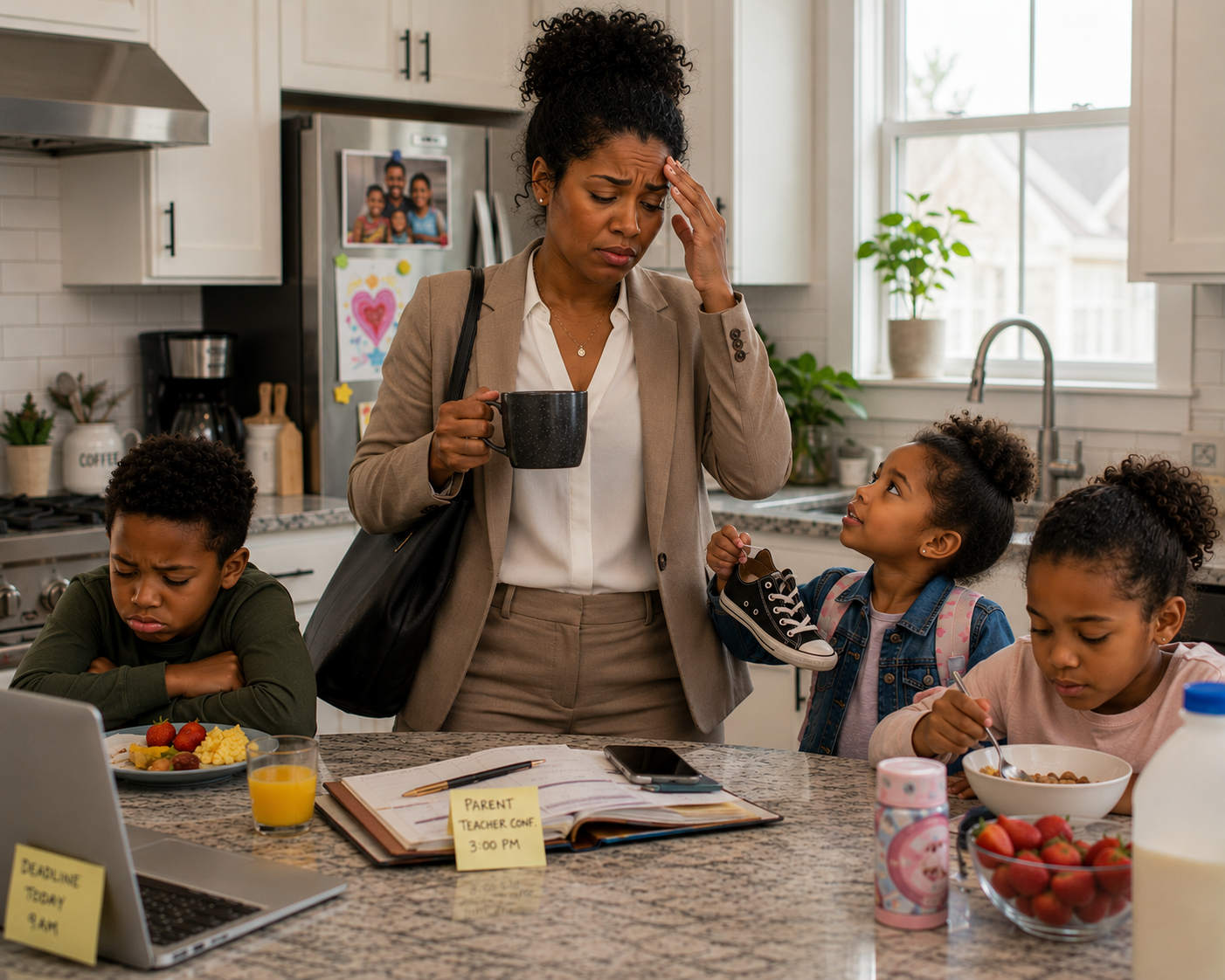
It's 7:14 a.m.
Someone can't find their shoes.
Someone else suddenly hates the breakfast they asked for.
The dog needs to go outside.
You're already running late.
Your coffee is getting cold.
And before you've even left the house, you've answered 37 questions, solved three problems, and forgotten what you walked into the room for.
By 8 a.m., you're exhausted.
Not because you're doing something wrong.
Because you're carrying more than most people realize.
If you're a mom who feels overwhelmed, stretched thin, emotionally exhausted, or like you're constantly behind no matter how hard you try, you're not alone.
Many of the mothers we work with at Mindful Healing Counseling describe feeling like they're barely keeping their heads above water. They love their children deeply. They wouldn't trade them for the world. Yet they often find themselves wondering:
Why am I so overwhelmed all the time?
Why does motherhood feel harder than everyone said it would?
Why am I constantly exhausted?
Why does it feel like everyone needs something from me?
Why can't I keep up?
These questions don't mean you're failing.
They mean you're human.
And they often point to something many mothers are carrying: the mental load of motherhood.
Why Do Moms Feel So Overwhelmed?
Many people assume overwhelm is a time-management problem.
But for most mothers, it isn't.
The issue isn't that you're disorganized.
The issue isn't that you need a better planner.
The issue isn't that you need to wake up earlier.
The issue is that you're carrying an enormous amount of invisible labor.
You're not just managing tasks. You're managing an entire ecosystem. On an average day, you’re:
Remembering birthdays
Scheduling appointments
Keeping track of school events
Monitoring emotional needs
Planning meals
Anticipating problems
Coordinating schedules
Managing household responsibilities
Making sure everyone has what they need
Most of this work happens silently.
And because it happens silently, it often goes unnoticed.
But your brain notices. Your nervous system notices. Your body notices.
Eventually, the weight of carrying everything starts to show up as anxiety, irritability, exhaustion, resentment, burnout, difficulty concentrating, or feeling disconnected from yourself.
The overwhelm isn't a sign that you're incapable.
It's often a sign that you've been carrying too much for too long.
Why Does Motherhood Feel So Hard?
This is one of the most common questions mothers silently carry.
Not because they don't love their children.
Not because they regret becoming parents.
But because modern motherhood often asks women to do the work that entire communities once shared.
Many mothers today are expected to:
Work outside the home
Manage household responsibilities
Coordinate schedules
Handle emotional labor
Support aging parents
Maintain relationships
Stay physically healthy
Be emotionally available
Keep up with school communication
Plan meals
Manage finances
Remember everything
And somehow do all of it with a smile.
If motherhood feels hard, it may not be because you're doing it wrong.
It may be because you're carrying an impossible amount of responsibility.
Many moms spend years believing they need to become more efficient when what they actually need is more support.
Why Does Motherhood Feel Harder Than It Looks?
Because much of the work is invisible.
People see the soccer game.
They don't see the registration.
The reminders.
The transportation.
The snacks.
The scheduling.
People see dinner on the table.
They don't see the mental energy it took to plan the meal, shop for ingredients, prepare the food, and clean up afterward.
People see your child arrive at school.
They don't see everything that happened before the school bell rang.
Invisible work is still work.
And invisible work is exhausting.
The Mental Load of Motherhood Is Real
The mental load refers to the ongoing cognitive and emotional labor involved in managing a family.
It's the constant planning, organizing, anticipating, remembering, and problem-solving that happens behind the scenes.
For example:
You remember that your child has spirit week next Thursday
You notice the milk is almost gone
You realize your daughter needs new shoes
You remember the permission slip
You schedule the dentist appointment
You buy the birthday gift
You coordinate childcare
You think about dinner while eating lunch
You think about tomorrow while trying to survive today
And often, you're doing all of this while working, parenting, maintaining relationships, and attempting to care for yourself.
No wonder you're tired.
No wonder your brain feels overloaded.
No wonder you're overwhelmed.

Why Self-Care Advice Often Misses the Mark
If you've ever wanted to roll your eyes when someone tells you to "just practice self-care," you're not alone.
Many moms feel frustrated by self-care advice because it often ignores reality.
Things like:
Take a bubble bath
Book a massage
Go away for the weekend
Plan a vacation
Those things can absolutely be wonderful.
But when you're trying to keep your family functioning, they may feel completely unrealistic.
The problem isn't that self-care doesn't matter.
The problem is that overwhelmed mothers often need support before they need self-care.
You cannot solve chronic overload with occasional relaxation.
What many moms actually need is:
More support
Healthier boundaries
Less pressure
Realistic expectations
Shared responsibility
Permission to stop carrying everything alone
What Is Mom Burnout?
Mom burnout is more than feeling tired.
It is a state of physical, emotional, and mental exhaustion caused by chronic stress and caregiving demands.
Many mothers don't realize they're burned out because they keep functioning.
They keep showing up.
They keep taking care of everyone else.
They keep pushing through.
But internally, they're running on empty.
Signs of Mom Burnout
You may be experiencing mom burnout if you:
Feel exhausted even after sleeping
Have little patience left
Feel emotionally numb
Cry more easily
Feel detached from yourself
Have difficulty concentrating
Feel resentful
Feel like you're always behind
Dread responsibilities you once handled easily
Struggle to enjoy things you used to enjoy
What Causes Mom Burnout?
Mom burnout often develops from a combination of factors:
Mental load overload
Lack of support
Financial stress
Relationship difficulties
Lack of personal time
Parenting children with higher support needs
Unrealistic expectations
Burnout is not a reflection of how much you love your family.
It's often a reflection of how much you've been carrying without enough support.
Burnout is not weakness.
It's a signal.
Your mind and body are telling you something needs to change.
Why Am I So Angry as a Mom?
This question surprises many mothers.
Because underneath the anger is often something else.
Exhaustion.
Overwhelm.
Resentment.
Loneliness.
Feeling unsupported.
Feeling unseen.
Feeling like everyone needs something from you while nobody is asking what you need.
Anger is often the emotion that appears when other emotions have gone unaddressed for too long.
Why Am I Yelling More Than I Want To?
When your nervous system is overloaded, your emotional bandwidth shrinks.
The questions that normally wouldn't bother you suddenly feel unbearable.
The whining feels louder.
The mess feels bigger.
The sibling conflict feels more intense.
The spilled milk feels like the final straw.
Not because you're a bad parent.
Because you're exhausted.
Many moms don't need better anger management.
They need:
More support
More rest
More boundaries
Less responsibility
More compassion for themselves
Why Do I Feel Guilty All the Time as a Mom?
Mom guilt is one of the most common concerns mothers bring into therapy.
You feel guilty when you work.
You feel guilty when you don't work.
You feel guilty when you need a break.
You feel guilty when you're tired.
You feel guilty when you say no.
You feel guilty when you're not fully present.
You feel guilty when you are present but neglecting something else.
It's a game with no winning outcome.
The Truth About Mom Guilt
Much of mom guilt comes from unrealistic expectations.
Mothers are often expected to:
Be endlessly patient
Be emotionally available at all times
Put everyone else's needs first
Never need a break
Love every moment
Never complain
These expectations are impossible.
Healthy motherhood includes:
Having needs
Making mistakes
Asking for help
Taking breaks
Setting boundaries
Being human
You can be a wonderful mother and still need support.
Why Can't I Handle Everything Anymore?
Many mothers ask this question after years of functioning at an incredibly high level.
You may have spent years being the dependable one.
The organized one.
The capable one.
The strong one.
Then suddenly it feels like your capacity disappears.
You forget things.
You cry more easily.
Small tasks feel overwhelming.
You wonder what happened.
Often, the answer is simple.
You reached your limit.
The problem isn't that you've become weaker.
The problem is that you've been carrying too much for too long.
There is a difference between being capable and being overloaded.
Many mothers confuse the two.
The Hidden Cost of Being the Strong One
Being the strong one often comes with a price.
When everyone depends on you, it becomes easy to lose sight of your own needs.
You become the problem-solver.
The planner.
The caregiver.
The emotional support person.
And eventually, you may start to wonder:
Who takes care of me?
Who notices when I'm struggling?
Who asks what I need?
Many women feel guilty even asking these questions.
But they're important.
Because everyone needs support.
Even the strong ones.
Especially the strong ones.

Why Do I Feel Like I've Lost Myself Since Becoming a Mom?
For many mothers, the overwhelm isn't just about being busy.
It's about feeling like you've disappeared.
You used to have interests.
Goals.
Hobbies.
Dreams.
Parts of your identity that had nothing to do with packing lunches, managing schedules, or remembering spirit week.
Then motherhood arrived.
And slowly, almost without noticing it, your life began revolving around everyone else's needs.
You became the one who remembers.
The one who plans.
The one who coordinates.
The one who anticipates problems before they happen.
The one who makes sure everyone else is okay.
And somewhere along the way, you stopped asking yourself a simple question:
Am I okay?
Many mothers carry a quiet grief that feels difficult to talk about.
Not because they don't love their children.
Not because they regret becoming parents.
But because they miss themselves.
They miss spontaneity.
They miss having time to think.
They miss pursuing interests that belonged only to them.
They miss feeling like a whole person instead of a role.
If you've ever thought:
I don't even know who I am anymore.
Everything revolves around everyone else.
I feel invisible.
I can't remember the last time I did something just for me.
I love my family, but I miss the version of myself I used to be.
You are far from alone.
This experience is incredibly common among mothers.
And it doesn't make you selfish.
It makes you human.
The truth is that motherhood changes us.
Some of those changes are beautiful.
Some are painful.
Many are both at the same time.
You can deeply love your children while also grieving the freedom, identity, and independence you once had.
Those experiences can coexist.
One does not cancel out the other.
Reconnecting with yourself doesn't require abandoning your family.
It starts with remembering that you are more than what you do for other people.
You are still in there.
The version of you who had dreams, interests, opinions, needs, and desires didn't disappear.
She may simply be buried underneath years of responsibility, exhaustion, and caring for everyone else.
Part of healing overwhelm is learning to reconnect with her again.
If you've found yourself wondering where you went in the midst of motherhood, you may also find our article, "Why Do I Feel Like I've Lost Myself Since Becoming a Mom?" helpful.
A Note From One Mom to Another
As both a psychologist and a mother, I know firsthand that motherhood can feel overwhelming in ways that are difficult to explain.
I know what it's like to wake up already thinking about school schedules, appointments, meals, work responsibilities, and everything else that needs to happen before the day is over.
I know what it's like to feel pulled in a dozen directions at once, the frustration of feeling overstimulated and overworked, while trying to be present for the people who matter most.
And I know how easy it is for mothers to put themselves at the bottom of their own list.
One of the things I've learned, both personally and professionally, is that needing support doesn't mean you're failing.
It means you're human.
You don't have to wait until you're completely burned out to care for yourself.
You deserve support, too.
How Do I Stop Feeling Overwhelmed Every Day?
There is no perfect solution.
But there are meaningful steps you can take.
Audit Your Mental Load
Ask yourself:
What am I carrying that nobody else even knows about?
What responsibilities could be shared?
What am I doing because I genuinely want to?
What am I doing because I feel obligated?
Awareness is often the first step toward change.
Let Go of Unnecessary Perfection
Not every meal needs to be homemade.
Not every event needs Pinterest-worthy decorations.
Not every holiday needs to be magical.
Not every moment needs to be meaningful.
Children benefit more from a regulated parent than a perfect one.
Build Support Before You're Desperate
Many mothers wait until they are completely burned out before seeking support.
Support works best before you hit a breaking point.
Support may include:
Family members
Friends
Childcare
Parent groups
Community resources
Therapy
You were never meant to do all of this alone.

Practical Ways to Cope When Life Feels Like Too Much
If you're overwhelmed right now, you don't need a perfect routine.
You need realistic strategies.
1. Lower the Bar Strategically
Ask yourself:
What actually matters today?
What can wait?
What can be simplified?
What can be delegated?
Sometimes "good enough" is exactly what is needed.
2. Stop Treating Rest Like a Reward
Many moms believe they can rest once everything is done.
The problem is that everything is never done.
Rest is not something you earn.
Rest is a basic human need.
3. Create Micro-Rest Moments
You don't need an entire weekend away.
Try:
Sitting in silence for five minutes (noise cancelling ear buds available are a plus)
It’s ok to say “Mommy’s ears need a break”
Taking a short walk
Listening to music
Drinking your coffee or glass of iced tea without multitasking
Taking a few deep breaths or sitting in your car for a few extra minutes before walking into the house
Small moments matter.
4. Ask for Specific Help
Instead of saying, "I need help," try:
Can you handle bedtime tonight?
Can you schedule the appointment?
Can you make dinner tomorrow?
Can you take the kids for an hour?
Specific requests are easier for others to understand.
5. Practice Self-Compassion
Many mothers speak to themselves in ways they would never speak to a friend.
Notice your inner dialogue.
If a friend came to you exhausted and overwhelmed, would you tell her she was failing?
Probably not.
Offer yourself the same compassion.
What If I'm Not Just Overwhelmed?
Sometimes overwhelm is temporary.
Sometimes it points to something deeper.
Persistent overwhelm can overlap with:
Perfectionism
People-pleasing
Burnout
If you find yourself feeling overwhelmed most days, struggling to enjoy life, constantly anxious, emotionally disconnected, or unable to remember the last time you felt like yourself, it may be time to reach out for support.
For many mothers, overwhelm and anxiety go hand in hand. You can learn more about our Anxiety Therapy in Illinois services and how treatment can help reduce chronic worry, overthinking, and stress.
You don't have to wait until you're falling apart.
What Therapy Can Help With
Many mothers come to therapy believing they need to become more productive.
What they often discover is that they need support.
Therapy can help you:
Manage anxiety and stress
Reduce overwhelm
Set healthier boundaries
Navigate mom guilt
Process resentment without shame
Reduce perfectionism
Improve communication
Reconnect with yourself
Feel more supported
Most importantly, therapy provides a space where someone is finally focused on you.
Not your children.
Not your partner.
Not your job.
You.
If you're looking for additional support, learn more about our Online Therapy for Moms in Illinois services and how therapy can help you move from survival mode toward feeling more balanced and supported.
You Are Not Failing
If motherhood feels harder than you expected, it doesn't mean you're doing it wrong.
If you're overwhelmed, it doesn't mean you're weak.
If you're exhausted, it doesn't mean you're ungrateful.
If you're struggling, it doesn't mean you're failing.
It may simply mean you've been carrying too much for too long.
The truth is that many mothers are trying to do the work of multiple people while holding themselves to impossible standards.
That's not a personal failure.
That's a recipe for burnout.
So if you're reading this while sitting in a school pickup line, hiding in the bathroom for five minutes of peace, reheating your coffee for the third time, or wondering how you're supposed to keep doing all of this tomorrow, know this:
You are not alone.
You are not broken.
You are not the only mother who feels this way.
And you do not have to carry it all by yourself.
Frequently Asked Questions About Feeling Overwhelmed as a Mom
Why Am I So Overwhelmed as a Mom?
Many mothers feel overwhelmed because they are carrying the mental load of motherhood, including parenting responsibilities, household management, work demands, emotional labor, and caregiving. Feeling overwhelmed is often a sign that you're carrying too much, not that you're failing as a parent.
Is It Normal to Feel Overwhelmed as a Mom?
Yes. Most mothers experience periods of overwhelm, especially during busy seasons of life. However, if you constantly feel exhausted, anxious, resentful, or like you're barely keeping up, it may be time to seek additional support.
Why Does Motherhood Feel So Hard?
Motherhood often involves managing multiple responsibilities at the same time while receiving little recognition for the invisible work involved. Many moms are balancing parenting, work, relationships, household responsibilities, and the mental load of keeping everything running.
What Is the Mental Load of Motherhood?
The mental load of motherhood refers to the invisible planning, remembering, organizing, and emotional labor involved in managing family life. This can include scheduling appointments, remembering school events, planning meals, coordinating childcare, and anticipating the needs of others.
What Are the Signs of Mom Burnout?
Common signs of mom burnout include chronic exhaustion, irritability, emotional numbness, resentment, feeling detached from yourself or your family, difficulty concentrating, and feeling like you're constantly running on empty.
Why Am I So Angry as a Mom?
Many mothers experience increased irritability when they are overwhelmed, exhausted, unsupported, or carrying too much responsibility. Anger is often a signal that emotional needs have gone unmet for too long and that additional support may be needed.
Why Do I Feel Like I've Lost Myself Since Becoming a Mom?
Many mothers find that parenting consumes so much of their time, energy, and attention that they lose touch with parts of their identity. This experience is common and does not mean you love your children any less. Reconnecting with yourself is an important part of maternal well-being.
How Can Therapy Help Overwhelmed Moms?
Therapy can help mothers manage stress, reduce anxiety, navigate mom guilt, improve boundaries, address burnout, reconnect with themselves, and develop healthier ways of coping with the demands of motherhood. Many moms find therapy provides a supportive space focused on their needs and well-being.
Find Support for Overwhelming Motherhood Stress
You don't have to wait until you're completely burned out to ask for help.
At Mindful Healing Counseling, we provide online therapy across Illinois for overwhelmed moms who are struggling with stress, anxiety, burnout, perfectionism, mom guilt, and the mental load of motherhood.
Together, we can help you carry less, breathe easier, and reconnect with the version of yourself that exists beyond your endless to-do list.
Because motherhood is hard.
And you deserve support, too.

About the Author
Dr. Aretha Steele, PsyD, is a Licensed Clinical Psychologist, mother of three, and the founder of Mindful Healing Counseling, a group therapy practice providing online therapy across Illinois.
Dr. Steele specializes in anxiety, trauma, women's mental health, motherhood, perfectionism, and life transitions. As both a psychologist and a mother, she understands the unique pressures many women face while balancing parenting, relationships, work, and the mental load of everyday life.
Through Mindful Healing Counseling, Dr. Steele has built a team of compassionate therapists who support overwhelmed moms, women, caregivers, LGBTQIA+ individuals, and Black, Brown, and other historically marginalized communities navigating stress, burnout, anxiety, life transitions, and the challenges of modern life.
If you're feeling overwhelmed, exhausted, or like you've lost yourself in the demands of everyday life, our team is here to help.
Learn more about our therapists or complete our matching form to find the best fit for your needs.